
Not Every Knot is Easy to Untie: New Fathers' Health Campaign Launches on Fathers Day
Special Projects
Male Youth
CONTACT
Justin Trottier, Executive Director
Canadian Centre for Men and Families
jtrottier@menandfamilies.org
416-402-8856
Not Every Knot is Easy to Untie:
New Fathers’ Health Campaign Launches on Fathers Day
The Canadian Centre for Men and Families (CCMF) is launching a targeted Father’s Day advertising campaign designed to spark crucial conversations around men’s mental health, break down the stigma preventing men from seeking help, and directly connect vulnerable fathers and their loved ones to critical support resources.
Anchored by a series of distinct visual creatives, the campaign features three core assets:
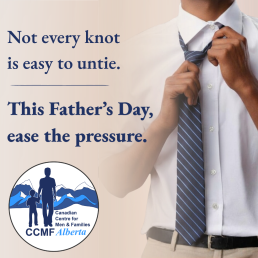
the first broadly addresses the heavy weight of men’s mental health issues with a powerful image of a man loosening his tie under the message “Not every knot is easy to untie”;
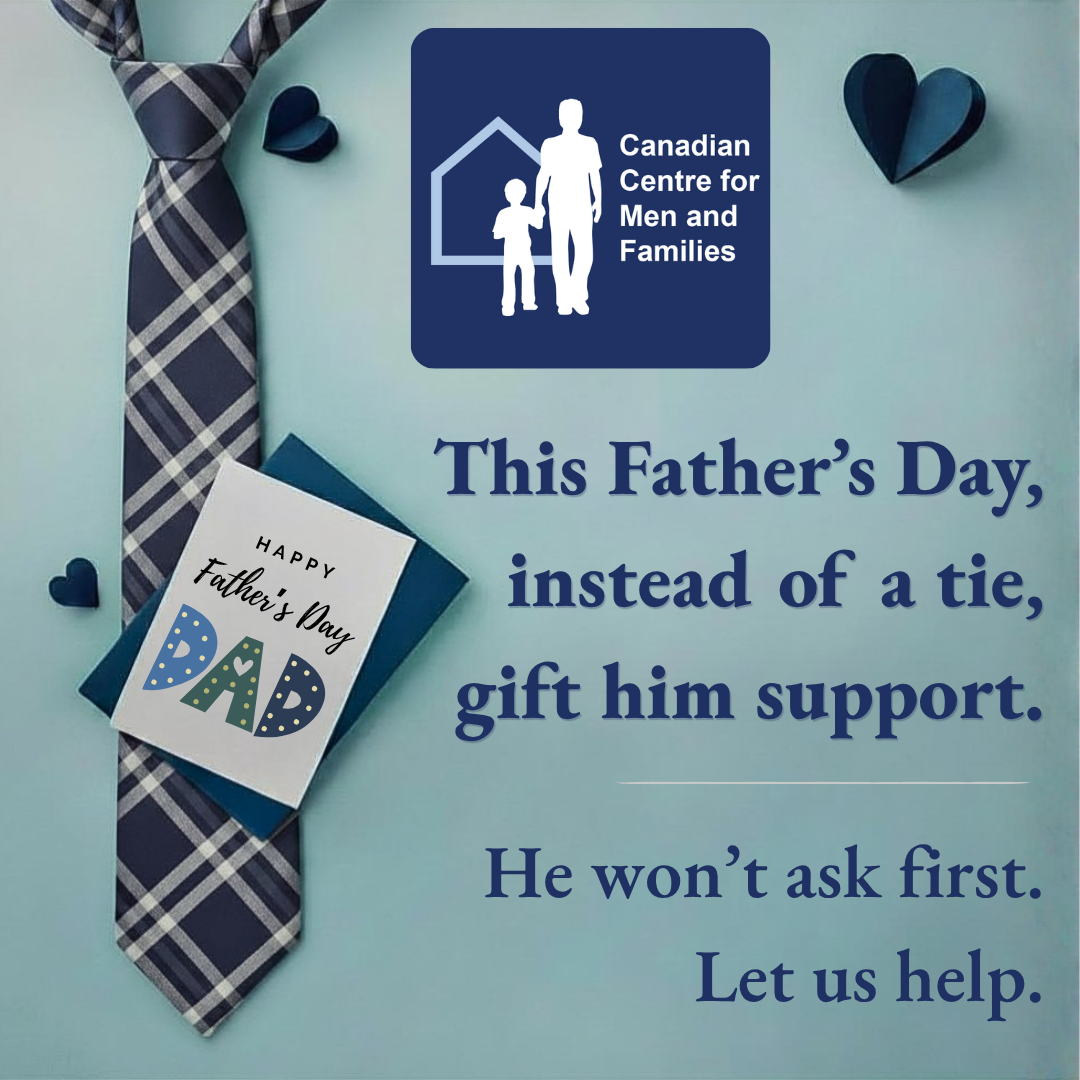
the second speaks directly to the families and loved ones of fathers, using a traditional holiday tie layout to remind them that “He won’t ask first”;
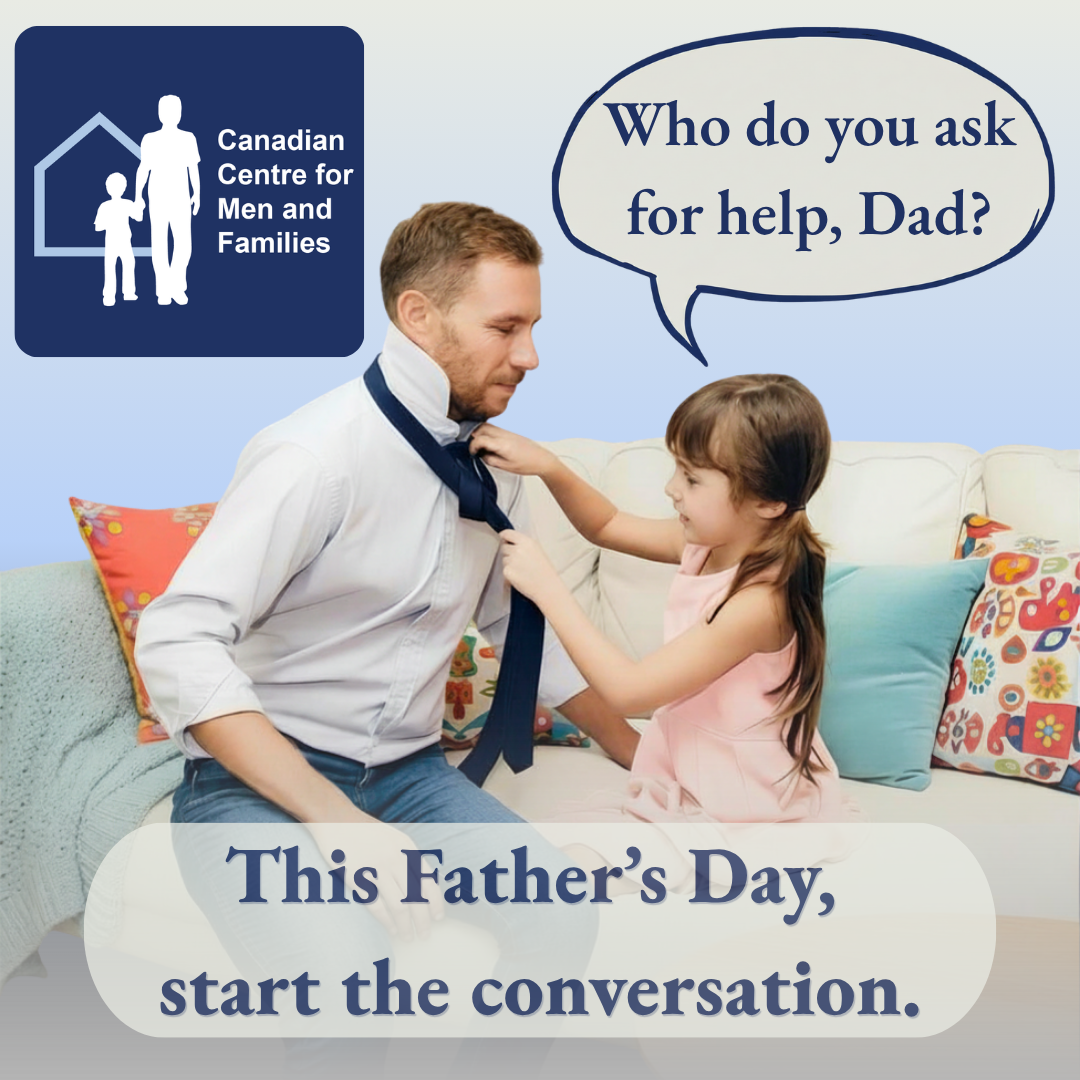
the third features a heartwarming illustration of a young daughter asking her father who he turns to for help, urging families to “start the conversation.”
To maximize reach and impact, the initiative will leverage hyper-targeted social media placements across Facebook, Instagram, and Google, utilizing distinct campaign hashtags to drive engagement. Each creative is embedded with a unique QR code that seamlessly bridges the gap between awareness and action, routing users back to the CCMF national website where they can immediately access localized programs, counseling, and peer support services.
By establishing a strong foundational footprint this Father’s Day, CCMF intends to scale this initiative into a signature annual campaign, progressively expanding its reach into new geographic regions and demographic markets to create lasting, generational change for fathers across the country.
Join the conversation using hashtags: #MensMentalHealth #Supports4MenAndBoys #UntieTheKnot #LoosenThePressure

Male Role Models in Early Years Scholarship
Special Projects
Male Youth
CONTACT
Justin Trottier, Executive Director
Canadian Centre for Men and Families
jtrottier@menandfamilies.org
416-402-8856
Male Role Models in Early Years Scholarship
The Male Role Models in Early Years Scholarship was established to support and encourage men pursuing a career in early childhood education (ECE). Recognizing the importance of diverse role models in early learning environments, this scholarship aims to increase male representation in a field where men remain significantly underrepresented.
Early childhood educators play a critical role in shaping the social, emotional, and cognitive development of young children. Greater gender diversity within the profession benefits children, families, and communities by fostering inclusive environments and broadening the range of perspectives and experiences available to young learners.
This scholarship is awarded to a male student who has demonstrated a strong commitment to working with young children and a clear intention to pursue a career in early childhood education. Applicants should show a combination of academic dedication, relevant experience, and a genuine passion for supporting the development and well-being of children.
Eligibility Criteria
Applicants must:
- Identify as male
- Be accepted into or currently enrolled in a recognized Early Childhood Education (ECE) program anywhere in Canada
- Demonstrate a commitment to a career in early childhood education
- Meet any additional academic or institutional requirements (if applicable)
Selection Criteria
Recipients will be selected based on:
- A personal statement outlining their interest in early childhood education and the importance of male educators in the field
- Academic achievement
- Relevant work, volunteer, or caregiving experience
- Strength of character, leadership, and community involvement
Award Details
- Award amount: $1,500
- Number of recipients: 1
- Frequency: One-time
- Applications may be submitted anytime between March 1st and June 30th each year. The successful applicant will be notified by July 31st.
- Applications must include documentation confirming acceptance into a Canadian ECE program.
- Submit application to info@menandfamilies.org with subject heading “Application for Male Role Models in Early Years Scholarship”.
For further information, please contact info@menandfamilies.org
Canadian National Strategy for Men’s Mental Health
Contact
info@menandfamilies.org
Canadian National Strategy for Men’s Mental Health
ACT BOLD FOR MEN AND BOYS
Recommendations from the Canadian Centre for Men and Families (CCMF)
Comprehensive
An effective men’s health strategy must incorporate a wide variety of areas, including the job sector, family courts, the educational system, and male identity. It must be interdisciplinary, recognizing that legal stress, financial strain, family breakdown, domestic abuse, and youth struggles all interact to shape men’s mental health outcomes.
This strategy requires the engagement of multiple government ministries, including Health, Public Safety, WAGE, Housing, Indigenous Services, Employment and Social Development, Veterans Affairs, and Justice.
The Strategy must address social determinants of health – those core causes of suicide and mental health issues in men – without excluding politically complex topics, provided the analysis is evidence-based and trauma-informed. As one critical example, men commit suicide at 6-8 times the rate of women when going through family separation and facing loss of their children.
Service Oriented
The Strategy must move beyond a research-only focus toward adequately funded service delivery. Agencies that demonstrate a history of delivering services to men should be a priority. The government should invest in a Canada-wide Men’s Health Centre by scaling up the existing infrastructure of the Canadian Centre for Men and Families.
CCMF is the country’s leading national charity operating evidence-based and effective interventions for boys and men. We focus on the key triggers of male suicide, such as family break down, family violence, addiction and employment loss. Our network of branches across the country services over 2,000 new families each year across all demographic lines. CCMF is training dozens of external agencies across Canada as they expand their services for boys and men.
We recommend a national 24/7 crisis line with staff specifically trained in male-centric de-escalation and resource referral.
We encourage the incentivization of “Mental Health Safety Standards” in male-dominated trades by providing tax credits to companies that implement on-site counseling and peer-support programs tailored to blue-collar workers.
Rethinking Family Violence
Statistics Canada data and scholarly research underline the urgent need to move toward gender equality in services for family and domestic violence victims. The government must implement the recommendations contained in the landmark report, Male Survivors of Intimate Partner Violence in Canada (2020), prepared for the Federal Ombudsman for Victims of Crime, to direct federal funding toward the creation of domestic violence shelters specifically for men and their children, along with directing the CMHC to fund and finance transitional and affordable housing for father-led families in crisis.
Father Involvement
Research shows that children achieve their best social and health outcomes with two maximally involved parents. We recommend public policies that encourage active and involved fathers. Most urgently, we recommend reforming the Divorce Act to establish a rebuttable presumption of equal shared co-parenting as being in the best interests of the child, except in cases of proven abuse or neglect. Relatedly, we recommend updating the Income Tax Act to remove the “female primary parent presumption” of the Canada Child Benefit, which currently discriminates against children based on the gender of their primary caregiver.
Promoting Positive Perceptions of Masculinity
Men and boys are frequently portrayed as “toxic” or incompetent (the “bumbling father” trope) in mainstream media. This negative reinforcement creates a deficit-based identity for boys, leading to alienation. Consequently, many men avoid seeking help not because they reject care but because they fear shame, disbelief and judgement.
We recommend the federal government update its communications to remove language of “toxic masculinity” and other shaming language in favour of language that is positive, supportive, and affirming of boys and men.
We recommend the creation of marketing campaigns to encourage young men to enter health, education, and social services as viable career paths.
We recommend a specific stream within the Canada Media Fund (CMF) for content that portrays men in diverse, positive, and non-traditional roles. Relatedly, we recommend the launch of a federally funded “Value of Men” public service campaign to celebrate men as caregivers, educators, and community pillars.
Governmental
We recommend the appointment of an Associate Minister for Men’s Health (within Health Canada) to provide ongoing oversight of the implementation of the Strategy.
The Associate Minister for Men’s Health should be an observer member of the Parliamentary Caucus for Men and Boys Health which was launched in late 2025 under the leadership of Senator Patrick Brazeau. The Caucus currently consists of over 30 MPs and Senators, including Liberal, Conservative, NDP and Independent members.
Conclusion
The federal strategy represents a pivotal opportunity to address the long-overlooked health and social disparities facing men and boys in Canada, moving beyond a narrow focus on their utility to prioritize their holistic well-being. By adopting these interdisciplinary recommendations — ranging from gender-responsive mental health funding and legal reforms to educational revitalization and the promotion of positive masculinity — the government can dismantle the systemic barriers that lead to higher rates of suicide, educational dropout, and workplace fatalities. Ultimately, investing in the success and health of men is not merely a matter of gender equity; it is a vital investment in the stability of Canadian families and the long-term prosperity of society as a whole.
ORIGINAL FULL STATEMENT FOLLOWS
Executive Summary
The Canadian Centre for Men and Families (CCMF) is a national mental health and social services charity established in 2014, operating branches across Canada and serving over 2,000 new clients annually. CCMF serves men and boys of all backgrounds and identities, including Indigenous, racialized, newcomer, 2SLGBTQ+, rural and low-income men and boys.
We specialize in addressing the gender disparity in service access for boys and men across diverse communities and identities experiencing relationship breakdown, domestic and family abuse, social isolation, and other intersecting stressors (economic, cultural, and occupational).
Given that men account for approximately 75% of all suicide deaths in Canada, our mission is to provide gender-responsive support that mitigates this crisis. Scholarly research indicates that men in the acute phase of family separation are up to 8 times more likely to die by suicide than their female counterparts. Some groups of males, including young, Indigenous and minority males, are particularly at risk.
Our aim is to strengthen the effectiveness of the Men’s Mental Health Strategy. We will do this by referencing social determinants which account for the men’s health crisis, including the most tragic outcome of suicide. Our recommendations may introduce difficult subjects or politically challenging areas, but we do so because we believe that only by taking both a comprehensive and a deep approach can we develop an effective Strategy.
Recommendations from the CCMF for the Canadian National Strategy
Scope and Framework
An effective men’s health strategy must incorporate a wide variety of areas, including the job sector, family courts, the educational system, and male identity. It must address interconnected systems—workplaces (including high-risk and low-wage sectors), family law, education, justice, and community life—as well as evolving concepts of masculinity.
It must be interdisciplinary, recognizing that legal stress, financial strain, family breakdown, domestic abuse, and youth violence all interact to shape men’s mental health outcomes. This strategy requires the engagement of multiple government ministries, including Health, Public Safety, WAGE, Housing, Indigenous Services, Employment and Social Development, Veterans Affairs, and Justice.
It needs to move beyond a pure research-only focus to adequately funded and sustained evidence-informed interventions and service delivery
The strategy must address the core causes of suicide and mental health challenges without excluding politically complex topics, provided the analysis is evidence-based and trauma-informed. It must move beyond research-only initiatives toward adequately funded service delivery, including scaling up existing infrastructure by supporting agencies with a long history of effective service to men.
Specific Needs-Based Recommendations
- Specific Funding for Men’s Mental Health Services
- The Need: There is a systemic gap in services specifically targeted at the mental health of boys and men.
- Recommendations:
- Provide dedicated federal funding for gender-responsive psychotherapy, peer-led group trauma recovery, and evidence-based parenting courses for fathers.
- Establish a national 24/7 crisis hotline with staff specifically trained in male-centric de-escalation and resource referral.
- Re-assess current social and health programs to ensure they are not based on biased understandings of gender roles.
- Stronger Promotion of Men’s Health
- The Need: Men engage the medical establishment less frequently than women, even though they are at a higher risk of negative health outcomes, such as most cancers.
- Recommendation: Initiate a national marketing strategy that reminds men they matter and emphasizes the importance of nutrition, exercise, and regular medical screenings.
- Legal Navigation & Support for Male Victims of IPV
- The Need: Many men face the “procedural misuse” of legal and bureaucratic systems during relationship breakdowns—where these systems are used as tools of harassment. Men also struggle with the high costs of legal representation and supervised access, which can sever the father-child bond.
- Recommendations:
- Fund legal clinics (modeled after the Barbra Schlifer Commemorative Clinic) dedicated to male and gender-diverse victims of intimate partner violence (IPV).
- Provide funding for family/criminal law navigators and subsidies for court-mandated supervised visits to ensure financial hardship does not separate fathers from their children.
- Expansion of Dedicated Male Domestic Violence Shelters
- The Need: A recent (2026) Statistics Canada Report indicates that about 50% of physical IPV victims are men, yet shelter capacity is severely skewed. While roughly 600 government-funded shelters exist for women, there are currently no equivalent government-funded shelters specifically for men and their children.
- Recommendation: Implement the recommendation of the Federal Ombudsperson for Victims of Crime by directing federal investment toward the creation of domestic violence shelters specifically for men and their children.
- Addressing the “Educational Disconnect” for Boys
- The Need: Boys generally underperform in the school system compared to girls, partly due to a lack of alternatives to the academic stream. This leads to long-term social and economic marginalization, social isolation, and an increased risk of anti-social behavior.
- Recommendations:
- Engage provinces to ensure schools recognize that boys may learn differently and adapt curricula accordingly.
- Revitalize technical and vocational education by implementing a pilot program based on the German “Dual System,” creating industry-school partnerships for high-paying, skill-based careers.
- Create marketing strategies to encourage young men to enter health, education, and social services as viable career paths.
- Restorative Justice in Family Court Allegations
- The Need: Unsubstantiated or malicious allegations of abuse during custody battles cause immense trauma and drain court resources. Even when exonerated, the “stigma of the charge” often persists.
- Recommendations:
- Explore restorative justice frameworks for low-risk IPV allegations within family court to prevent unnecessary criminalization.
- Implement a “Fast-Track Expungement” process for individuals cleared of allegations to protect their reputation and mental health.
- Review of Mandatory Charging Police Policies
- The Need: Current “primary aggressor” and mandatory arrest policies often rely on physical size differences. This can lead police to arrest a male victim even when he is the one who called for help, disincentivizing men from seeking protection.
- Recommendations:
- Engage provincial and territorial jurisdictions to transition from “mandatory charging” to “evidence-based charging,” granting police the discretion to assess the full context of a call.
- Mandate officer training that includes a better understanding of male IPV victimization to ensure stereotypes do not act as a barrier to support.
- Presumption of Equal Shared Co-Parenting
- The Need: The lack of an involved father is a leading indicator for youth suicide, incarceration, and substance abuse. A recent study has shown that jurisdictions with equal shared parenting see a significant drop in IPV (about 50%) and intimate partner homicides (about 8%).
- Recommendations:
- Reform the Divorce Act to establish a rebuttable presumption of equal shared co-parenting as being in the “best interests of the child,” except in cases of proven abuse or neglect.
- Amend the Income Tax Act to remove the “female primary parent presumption” for the Canada Child Benefit, which currently discriminates against children based on the gender of their primary parent.
- Investigating the Gender Sentencing Gap
- The Need: Data suggests that for identical offenses, men are more likely to be charged, convicted, and given longer custodial sentences than women.
- Recommendation: Commission a federal audit of the Canadian criminal justice system to identify and rectify gender bias in sentencing and conviction rates.
- Workplace Mental Health & Occupational Safety
- The Need: Men represent the vast majority of workplace fatalities and injuries, particularly in high-risk sectors and first-responder roles. These industries often lack integrated mental health support for trauma and burnout.
- Recommendation: Incentivize “Mental Health Safety Standards” in male-dominated trades by providing tax credits to companies that implement on-site counseling and peer-support programs tailored to blue-collar workers.
- Support for Indigenous and Marginalized Men
- The Need: Indigenous men experience the highest rates of suicide and incarceration in Canada, rooted in the intersection of historical trauma and gender-specific needs.
- Recommendation: Provide culturally specific funding for land-based healing programs and elder-led mentorship specifically for Indigenous men and boys, ensuring these programs are designed and governed by Indigenous communities.
- Longitudinal Research on Male Life Outcomes
- The Need: Current policy is often based on data that does not differentiate between the specific life trajectories of men and women.
- Recommendation: Establish a federal research fund for longitudinal studies focusing on male life outcomes, particularly the impact of father-absence, educational disengagement, and social isolation.
- Promoting Positive Masculinity & Media Literacy
- The Need: There is a pervasive “image gap” where men and boys are frequently portrayed as “toxic” or incompetent (the “bumbling father” trope). This negative reinforcement creates a deficit-based identity for boys, leading to alienation.
- Recommendations:
- Launch a federally funded “Value of Men” public service campaign to celebrate men as caregivers, educators, and community pillars.
- Create a specific stream within the Canada Media Fund (CMF) for content that portrays men in diverse, positive, and non-traditional roles.
- Establish national awards to recognize male-led grassroots initiatives focusing on mentorship and healthy relationships.
- Appointment of an Associate Minister for Men’s Health (within Health Canada)
Conclusion
The upcoming federal strategy represents a pivotal opportunity to address the long-overlooked health and social disparities facing men and boys in Canada, moving beyond a narrow focus on their utility to prioritize their holistic well-being. By adopting these interdisciplinary recommendations—ranging from gender-responsive mental health fundingand legal reforms to educational revitalization and the promotion of positive masculinity—the government can dismantle the systemic barriers that lead to higher rates of suicide, educational dropout, and workplace fatalities. There is an urgent need to transition from research to adequately funded service delivery that recognizes men as essential caregivers, innovators, and community pillars. Ultimately, investing in the success and health of men is not merely a matter of gender equity; it is a vital investment in the stability of Canadian families and the long-term prosperity of society as a whole.
Inspiring Boys, Empowering Fathers, Transforming Lives
Contact
Inspiringboys@menandfamilies.org
ACTION ITEMS
Do you have questions or suggestions?
Feel free to send us questions about helping your son become successful. We will do our best to provide a response. Here is our email: Inspiringboys@menandfamilies.org
Also, if you are a father and have suggestions for other fathers, please add them to the discussion.
Inspiring Boys, Empowering Fathers, Transforming Lives
Healthy Fathers, Healthy Sons, Health Communities
“The underachievement of boys in the education system is a really serious issue faced by parents, teachers and all of society.”
– Dr. James S. Brown, MA, MEd EdD, Author of Rescuing our Underachieving Sons
“Boys are falling behind in education, mental health, and a sense of purpose—creating a crisis that affects families, communities, and the future of our society.”
– Dr. Warren Farrel, Author of The Boy Crisis
“In discussing gender differences in education, it’s crucial to consider the interaction of biology, culture, and education systems, recognizing that these differences are not immutable but can change with societal evolution and educational reforms. Moreover, the conversation must be sensitive to the diversity within each gender, acknowledging that individual experiences can significantly vary from these broad trends”.
– Christina Hoff Sommers. Author of The War on Boys
As we look around, it’s clear that boys are facing significant challenges in today’s society—especially in education, mental health, and relationships. Boys are increasingly falling behind in school, and a growing disparity between boys and girls is becoming more evident.
Historically, when girls faced barriers to success, society took proactive steps to level the playing field, helping them thrive. Now, boys are disengaging from education, social connections, and in some cases, even life itself. It’s time to adjust our approach, inspire our boys, and help them unlock their full potential. It’s time for us to shift our focus and create an environment where boys can succeed just as girls do today.
Data from the past decade shows alarming trends with boys: lower literacy scores, higher school dropout rates, increased depression, disengagement, lower post-secondary attendance, and rising unemployment along with substance abuse among young men. This lack of participation in society can often lead to depression and, tragically, suicide. A healthy society depends on healthy fathers, healthy sons, and healthy communities.
We need to inspire and support our boys today to ensure a better future for everyone. We envision a future where every boy is equipped to succeed academically, emotionally, and socially. By inspiring our boys now, we create a generation of leaders, innovators, and role models who will drive a brighter, more equitable future for all.
Let’s take action today—when our boys succeed, life improves for everyone.
Where do we see these differences in education and society?
- Lower Academic Performance Boys, on average, are performing worse than girls in school, with lower grades, and lower literacy, reading and writing skills
- Lack of Engagement Boys often show less interest in school and struggle with motivation.
- Boys typically score lower than girls on standardized tests in the language arts. (EQAO)
- Boys are more likely than girls to be placed in special education programs
- Decline in the percentage of boys attending post-secondary school
- Higher school drop rate Boys are more likely to drop out of school compared to girls
- Inability to enter a trade – often require a high school diploma or college eduction
- Decline in the number of boys entering professions
- Role models for boys are declining
- Boys view schools as places for women teachers to teach girls. Boys are often heard to say, “School is for girls”
Why is this an issue for CCMF?
When boys drop out of the education system, they often face significant long-term consequences across multiple areas of life, including employment, financial stability, health, and social well-being. CCMF helps men manage some of these challenges. The next step is to help fathers inspire their children, especially boys, so that they too can become high achievers in education, resulting in a better quality of life. Healthy Fathers, Healthy Families, Healthy Communities.
Why is this an issue for Women?
“When boys lose, women lose. When boys do well, women do well. The good news is that when we focus on the needs of boys, we will all benefit.”
Farrell, Warren. The Boy Crisis: Why Our Boys Are Struggling and What We Can Do About It. BenBella Books, 2018
When boys struggle—whether in education, emotional well-being, or social engagement—it directly impacts girls and women as well. This is partly because boys’ underachievement often leads to economic and social instability, which can affect families, relationships, and communities. Women need partners that are financially and emotionally stable in order to have a successful relationship and a healthy, happy homelife for the children.
What can we do about this?
CCMF is committed to helping fathers help their children. This new section of our website will provide monthly information on how fathers can help their sons succeed. We will continue to grow this section with more resources, data, videos and other features.
We also want to reach out to Fathers so they can share concerns and ideas. We can work with them to raise awareness and raise their sons to become healthy, educated and successful men.
How does CCMF support fathers?
In this new section of our CCMF website, our focus is on empowering fathers to better support their sons. Here’s how we can help:
- Monthly updates with valuable resources and topics for fathers
- Podcast discussions covering relevant subjects
- Opportunities for fathers provide feedback on podcasts, ask questions, and share their experiences
In an upcoming episode we will explore:
My son is struggling with Literacy. Why does it matter?
It is crucial that little boys learn to read, it has an impact on their quality of life and their future. More specifically:
Dr. James S. Brown emphasizes the importance of teaching young boys literacy as it is a foundational skill that affects nearly every aspect of their development and future success.
Reading is much more than simply decoding words and sentences—it’s about grasping the message the writer wants to convey. For example, a child might be able to sound out the word rune, but if they don’t understand that it’s an ancient symbol often found in fantasy stories like The Hobbit, they could miss an important part of the story. Understanding the meaning of words helps readers imagine the world the author is building. It’s about understanding what is being expressed in the story.
Reading also involves skills such as recognizing words, understanding grammar, and processing information presented in written form.
Literacy is beyond reading. It refers to the ability to read, write, and communicate effectively in various contexts. Literacy involves understanding and using language—both written and spoken—across different situations. It’s the ability to express ideas clearly (writing), understand complex information, think critically, and use language in meaningful ways. A common example is a joke. You can tell a joke but if the person doesn’t know the context, they won’t think it’s funny. In the same way, you can read but if you don’t understand the context it’s just a bunch of words. Literacy is both reading, understanding and applying.
These are critical life skills for personal relationships, professional success and financial stability.
It is crucial to start this process early, right from birth. Have your sons become familiar with stories and picture books.
Why does Literacy at such an early age matter?
- Academic Success
- Early reading skills set the stage for overall academic achievement. Boys who struggle with reading early on often fall behind in other subjects, leading to frustration and disengagement from school.
- Cognitive Development
- Reading helps boys develop critical thinking, problem-solving, and comprehension skills, which are crucial for their intellectual growth and ability to process information effectively.
- Language & Communication Skills
- Literacy improves vocabulary, grammar, and communication, enabling boys to express themselves clearly and confidently in both verbal and written forms.
- Emotional & Social Development
- Reading exposes boys to different perspectives, cultures, and emotions, helping them build empathy and social awareness. It also enhances their ability to understand and manage their own emotions.
- Behavioral & Psychological Benefits
- Boys who develop strong reading skills are less likely to experience frustration in school, which can lead to behavioral issues or disengagement. Literacy can also reduce anxiety by providing a constructive way to process thoughts and emotions.
- Future Career & Economic Opportunities
- Reading proficiency is directly linked to higher education attainment and better job prospects. Poor literacy skills limit career choices and earning potential.
- Preventing Dropout & Delinquency
- Boys who struggle with reading are more likely to become disinterested in school, leading to higher dropout rates and an increased risk of delinquency or criminal behavior.
- Encouraging a Lifelong Love for Learning
- If boys learn to read early and enjoy it, they are more likely to continue learning and exploring new ideas throughout their lives, leading to personal and professional growth.
Where is the data? What do the statistics tell us?
Here are key literacy statistics from various sources:
- Ontario EQAO (2014-2019):
- Grade 3: Girls outperformed boys by 8-10% in reading and 11-13% in writing.
- Grade 6: Girls again outperformed boys by 8-10% points in reading and 13-17% points in writing.
- Ontario Secondary School Literacy Test (OSSLT) 2018-2019:
- 81% of girls passed, compared to 75% of boys, creating a 6-point gender gap.
- This test is essential for high school graduation, which is often a requirement for apprenticeships in skilled trades and for entry into post-secondary education—making it a critical step for boys’ future success.
- Pan-Canadian Assessment Program (PCAP 2013):
- Girls scored 23 points higher than boys in reading, showing a persistent gender gap.
- Progress in International Reading Literacy Study (PIRLS 2016):
- Girls in Canada had higher reading scores than boys, continuing a long-standing trend.
These statistics highlight a significant literacy gap favoring girls, with implications for boys’ academic and future economic success. This data does not account for the impact of COVID-19 on student performance. It’s time to help boys close the gap and provide equal opportunities for both boys and girls.
High School Drop out rates:
2009/2010, 10.3% of young men aged 20 to 24 had dropped out of high school, while the rate for young women was 6.6%
Nunavut had the highest rate of men dropping out at 50.0% in 2007/2010.
Post Secondary Statistics:
2021 Enrollment Nationally:
56.3% Women
43.6% Men
University of Alberta Data: In the 2015-2016 academic year, women represented 54.7% of the University of Alberta’s student population, while men accounted for 45.3%.
Post Secondary Graduation Rates:
According to the OECD, 76% of women and 58% of men in Canada aged 25-34 have post secondary qualifications, marking a significant gender gap. Leading lower economic opportunities.
So, what can I do as a Father to help my son?
The biggest, simplest and low cost thing you can do as a father is read to your son and teach him literacy skills. Even just 10 to 15 minutes a day of reading or one book a night, one chapter a night. Then talk about it. This shows sons that fathers read books too, setting yourself up as a role model. Too often boys see moms reading to them and their primary school teacher is likely to be a woman, so he does not see men as part of learning and education.
When you are with your son, take a trip to the library and pick out some books to read together. You can read them at the library and/or take some books home. Focus on books that have boys as heroes and leaders or scientists and problem solvers. That gives them some role models that are boys and they can see the value of boys in the stories. After a few times, your son can see that he can have more personal time with Dad if he reads stories. Note that it is not likely your son will sit still as boys like to be constantly on the move and interacting with toys and other nearby distractions. That’s ok. Just keep reading and interacting with him about the story while he plays. He is listening! Most girls will sit still, most boys won’t, but that’s just biology.
It’s not just reading the book.
As part of the reading process, ask him questions:
- Tell the story back to you
- What does he think will happen next?
- Why did the character do what he did?
- What would you do if that were you?
- What is your favourite part of the story and why?
The goal is to engage your son and encourage critical thinking about the story.
Make it Personal
Another activity for a toddler or really any age, give him a book with his name written inside. It becomes his personal book, something he can carry around like a teddy bear. Encourage him to ask others to read to him or to explore the pictures on his own. The key is to show him the value of books.
Encourage your son to create his own story. After an experience, like going for ice cream or another type of outing, help him write about it. Print it out so he can have his own personalized storybook. He can draw pictures to go with the words. This process connects reading, writing, and thinking, and allows him to share his story, highlighting the value of his very own book.
As a father, what else can I do?
- Help your son to imagine possibilities with what he is learning is school – give role models/examples
- Provides lots of praise and positive feedback as he probably doesn’t get that in school
- Talk to him about exciting future goals – what do you want to be when you grow up? How do you get there?
- Help them with homework – be aware of what your son is learning in school! Ensure it supports positive vision for boys
- Advocate for your son by engaging actively with his teacher. When the teacher points out his weaknesses, seek out specific examples to understand these observations better. Use this information to work with your son, helping him to address and overcome these challenges. Through your support, demonstrate his growth and resilience, proving that what might have been seen as weaknesses can be transformed or are not weaknesses at all.
- Praise your son for being a boy and the value that boys/men bring to society. Tell them that in our society, the only way to get there is to stay in school and work hard. Perhaps reward him for working hard.
- Be a good role model – point out male role models for your son – real people, books, movies that portray boys a strong supportive roles
Summary:
Become a role model to your son, show him the importance of boys. Provide lots of positive reinforcement. Take a trip to the book store or library. Have him write a story about his time with his Dad. Make Literacy a priority for your son and play a crucial role in making him successful in life. He needs you!
What’s next:?
Get ready for something exciting and empowering! We’re launching a series of dynamic initiatives designed to support fathers in every possible way. A monthly podcast packed with powerful ideas and actionable tips on how fathers can help their sons thrive and succeed. But that’s not all! Fathers will have the chance to join the conversation with questions, suggestions, and even share their own experiences. We’ll also be interviewing experts and influential guests who can offer valuable insights and advice.
And that’s just the start! We’re building a thriving community with a blog where fathers can ask questions, share answers, and support each other. Plus, we’re curating a treasure trove of resources, including must-read books for dads and their sons. And as we grow, we’re introducing an online, live support group where fathers can connect, share, and find the encouragement they need. This is your chance to be part of something special—a movement of dads committed to making a lasting difference in their sons’ lives.
Do you have questions or suggestions?
Feel free to send us questions about helping your son become successful, we will do our best to provide a response.
Here is our email;
Inspiringboys@menandfamilies.org
Also, if you are a father and have suggestions for other fathers, please add them to the discussion.
Stay Tuned for future topics, discussions and details.
Take our Survey!
We would love to hear from you.
Please complete our survey, it takes 2 minutes and it will be anonymous unless you provide your email to us.
Suggested books with Boys as Heroes/Leaders by age:
“The more that you read, the more things you will know. The more that you learn, the more places you’ll go.” ― Dr. Seuss
Ages 0 to 4 years old:
Where the Wild Things Are by Maurice Sendak
The Gruffalo” by Julia Donaldson, illustrated by Axel Scheffler
Guess How Much I Love You by Sam McBratney
Curious George series by H.A. Rey
Jack and the Beanstalk
The Very Hungry Caterpillar by Eric Carle
The Little Engine That Could by Watty Piper
Doctor Suess books – help boys read by using catchy rhymes, simple vocabulary, and humorous stories that engage their imaginations. The colorful illustrations and repetitive language make reading fun and easier, building confidence and improving phonemic awareness. Themes of adventure and individuality resonate with boys, motivating them to keep reading.
Ages 4 to 8 years old:
The Adventures of Jack and Gizmo
The Adventures of Jamaal and Gizmo
The Adventures of Jay and Gizmo – By Dr. James S. Brown
Frog and Toad – by Arnold Lobel
Magic Tree House – chapter book series by Mary Pope Osborne
Several books in the series, usually 6 to 8 or older
Magic School Bus series by Joanna Cole
Ages 8 to 12 years old:
The Wind in the Willows by Kenneth Grahame
The Chronicles of Narnia series by C.S. Lewis
The Lion, the Witch and the Wardrobe
This series can be found in versions for different ages
Ages 12 to 15 years old:
Harry Potter and the Philosopher’s Stone/Sorcerer’s Stone by J.K. Rowling
Percy Jackson & The Olympians series by Rick Riordan
The Hobbit by J.R.R. Tolkien
Eragon series by Christopher Paolini
Artemis Fowl series by Eoin Colfer
The Maze Runner by James Dashner
Resources for Fathers to read:
Rescuing our underachieving sons
by Dr. James S. Brown, MA, MEd, EdD
The Boy Crisis: Why Our Boys Are Struggling and What We Can Do About It
by Warren Farrel
The War on Boys: How misguided policies are harming our young men
by Christina Hoff Sommers
Of Boys and Men – Why the modern male is struggling, why it matters and what to do about it.
By Richard V. Reeves


Erasing Family, a Documentary Film Co-Produced by CCMF
Public Policy
Male Youth
CONTACT
Justin Trottier, Executive Director
Canadian Centre for Men and Families
jtrottier@menandfamilies.org
416-402-8856
ACTION ITEMS:
Watch the film.
Learn more about parental alienation in order to reduce its prevalence.
Contact us and Get More Involved:
1. Organize your own screening.
2. Join or start a support group for alienated parents
3. Advance public policies that makes separation and divorce healthier for children.
Donate to support the film screening and policy work, receive charity receipt
Erasing Family, Co-Produced by the Canadian Centre for Men and Families, is a ground-breaking documentary film that spotlights the devastating consequences of parental alienation. The film led directly to global efforts to reform divorce and family law.
Contact us to arrange a screening.
A loving parent being erased from the life of his or her child is one of the most significant public health crises of our time. In Canada and the US, over 25 million parents are being erased – for no good reason – from their children’s lives after divorce or separation.
Watch the trailer for Erasing Family
For background on the film and to find out how you can watch it, visit https://erasingfamily.org/
Join a mass movement of citizens working to make progressive change happen across Canada.
Erasing Family spotlights the devastating consequences of parental alienation. The documentary follows young adults fighting to reunite with their broken families and offers a concrete road-map for public policy and community service improvements.
Nanos poll: 70% of Canadians support a rebuttable presumption of equal parenting and only 13% oppose it. See 2017 Nanos Equal Parenting Poll.pdf
Prior to these public events, the film was screened privately to great acclaim at the conferences for the Association of Family & Conciliation Courts, the American Psychological Association and the Parental Alienation Study Group
Testimonials
“It’s hard when you have to stop and think that your child wants nothing to do with you because of what they’ve been taught.”
– Dizzy Lerner, Alienated father, as interviewed in the documentray Erasing Family
“One parent gets to be a parent and the other gets to be at best a visitor and at worst completely erased.”
– Dr. Christine Giancarlo, Anthropologist, Mount Royal University (Calgary), and author, Parentectomy
“I want to hug my daughter but I can’t. And I couldn’t get any help.”
– Kris, Client, Father support group at the Canadian Centre for Men and Families
“Parental alienation devastates families. I’ve spoken to young fathers who were suicidal. There’s not much support, other than the Canadian Centre for Men and Families, for fathers who are alienated and trying to rebuild relationships with their kids”
– George, Client, Father support group at the Canadian Centre for Men and Families
About the Film
Erasing family bonds after divorce or separation is a leading cause of preventable childhood trauma. For change to happen, non-victims and institutions need to make divorce part of their agenda of social reform. Through personal narratives and legal analysis, Erasing Family educates families on how to make informed choices and mobilize representatives. Audiences will leave knowing that courtroom custody battles and their emotional consequences can be prevented with court reform and laws that promote shared parenting, as well as shifting resources to help families instead of encouraging them to fight.
Told from the point view of the children, Erasing Family attempts to heal from the consequences of courtroom decisions while endeavoring to build a DIY grassroots movement for social change. While the stories told are tragic, we show that happy endings are possible and inspire other children to reunite with their erased families.
The need is urgent. Although over 70% of Canadians support a presumption of equal parenting by mothers and fathers in the event of separation or divorce, and despite research showing that equal parenting has the best outcomes for children, legislative efforts have been repeatedly blocked. Efforts to reform family court by streamlining protocols and offering free or low cost mediation services remain fractured. We are determined to raise awareness that erasing family bonds after divorce or separation is one of the leading cause of preventable childhood trauma and through the film, trigger a mass movement to preserve family bonds.
CCMF hosted all Canadian Premiere Screenings of Erasing Family.
Past Canadian Premiere Events
Lethbridge: Saturday, November 9. Doors open 3:15pm. Movie starts 3:30pm. The Movie Mill @ 1710 Mayor Magrath Dr S, Lethbridge, AB T1K 2R5
Brampton: Wednesday, November 13 at 6:30PM. Brampton Towers Party Room, 85 Charolais Boulevard, Brampton, Ontario, L6Y2R8
Barrie, Ontario: Friday, November 22 at 7:00PM. 12 Chase McEachern Way, Barrie, ON, L4M1A1
Medicine Hat: Saturday, November 23 at 2:00pm. Esplanade Studio Theatre @ 401 First St SE, Medicine Hat, AB, T1A8W2
Calgary: Wednesday, October 9 at 7:00PM. Jenkins Theatre (Room I115), Mount Royal University. 4825 Mt Royal Gate SW., Calgary, Alberta, T3E 6K6
Toronto: Thursday, October 10 at 7:00PM and Friday, October 18 at 7:00PM. JJR Macleod Auditorium, Medical Sciences Building. 1 King’s College Circle, Toronto, Ontario, M5S3K1
Saskatoon: October 12, 2019 at 7:00PM
Edmonton: October 17 at 7:00PM. Theatre L1-190, Edmonton Clinic Health Academy (ECHA) Building, University of Alberta, 11405 87 Ave NW, Edmonton, AB T6G 1C9
Ottawa: Friday, October 18 at 7:00PM. Champlain Room, Ottawa City Hall, 110 Laurier Ave W, Ottawa, Ontario, K1P 1J1
Winnipeg: Saturday, October 19 at 2:30PM. Ambassador E Room, Canad Inns Destination Centre Windsor Park, 1034 Elizabeth Rd, Winnipeg, MB R2J 1B3, Dauphin, MB
Vancouver: Sunday, November 3. Doors open 2:00PM. Screening starts 3:00PM. The Theatre at UBC Robson Square, 800 Robson Street, Vancouver, BC Canada V6Z 3B7
MEDIA ADVISORY – FOR IMMEDIATE RELEASE
New Documentary Exposes Trauma Inflicted on Children by Canada’s Family Court System
Canadian Screenings of “Erasing Family” Start Oct 9th, Run in Calgary, Toronto, Ottawa, Edmonton, Vancouver, Winnipeg, Saskatoon, Lethbridge and Medicine Hat
TORONTO, ON — (October 8, 2019) – The new documentary Erasing Family gives voice to the avoidable trauma experienced by over one million Canadian children of divorcing parents. The film will premiere at venues across Canada starting October 9th, with screenings scheduled in Calgary, Toronto, Ottawa, Edmonton, Vancouver, Winnipeg, Saskatoon, Lethbridge and Medicine Hat.
The goal of this film is to make family break-up healthier for children by offering a concrete road-map for policy and service improvements. This message resonates with a broad consensus that we have a broken family law system that urgently needs repair.
“With an election around the corner, the film is a wake up call to policy makers to work toward structural reform that puts children first,” said Justin Trottier, Executive Director of the Canadian Centre for Men and Families, a men’s health agency that co-produced the film.
The film interviews activists for change who believe the most impactful remedy would be a presumption of equal parenting between mothers and fathers in the event of separation or divorce. Although a Nanos poll showed that 70% of Canadians support equal parenting and only 13% oppose it, and despite social science research demonstrating that equal parenting provides the best outcomes for children, legislative efforts have been repeatedly blocked.
The film’s prequel, Erasing Dad, which explored parental alienation in South America, was originally banned from YouTube because it exposed how some professionals make money by keeping parents and children separated. The ban was overturned, the film became incredibly popular and it helped to improve family law in Argentina.
For full information and the screening schedule, visit http://erasingfamily.ca
CONTACT
Justin Trottier
Executive Director,
Canadian Centre for Men and Families
jtrottier@menandfamilies.org
416-402-8856
The Canadian Centre for Men and Families is a men’s health and social service agency with offices across Canada.
-30-
CCMF Legal Fund
Public Policy
Male Youth
CONTACT
Justin Trottier, Executive Director
Canadian Centre for Men and Families
jtrottier@menandfamilies.org
416-402-8856
We received intervenor status in our first case before the Supreme Court of Canada.
In R v Langan, our legal team offered unique testimony on the use of male gender stereotypes in ascertaining credibility and argued before the highest court that false and damaging beliefs about male sexual insatiability should be seen as the male equivalents to the established rape myths.
Support the CCMF Legal Fund
This first success in receiving intervenor status makes it easier for CCMF to apply for standing in future cases and could allow us to impact landmark legal decisions that affect thousands of families. But only with your help.
Dr. James Brown's Odyssey for Equality, Sponsored by CCMF
Public Policy
Male Youth
CONTACT
Justin Trottier, Executive Director
Canadian Centre for Men and Families
jtrottier@menandfamilies.org
416-402-8856
After a forty year career in education, during which he has held virtually every position possible in the profession, Dr. James S. Brown is currently undertaking a new project aimed at raising public awareness about the issue of gender equality, especially as it applies in education. He has begun a multi-country tour, speaking with educational and community leaders about the problem of the increasing degree to which boys are underachieving in and disengaged by school, and the long-term consequences of our society’s apparent lack of interest in issues which impact disproportionately on boys.
The tour, which he is calling his Odyssey for Equality, includes stops in the UK, in a number of states in the USA, and in most of the Canadian provinces. The major theme is the problem of the underachievement of boys in school, its causes, consequences and solutions. Dr. Brown has already addressed groups in Florida in the USA, in Norwich and London in the UK, and in various locations in southern Ontario. He has an extensive schedule of meetings and presentations in Ontario in May and June, and in the western provinces in July and August. Please check the schedule and watch for the tour as it arrives in a location near you this summer.
The Canadian Centre for Men and Families is a proud sponsor of the “Odyssey for Equality” currently being undertaken by our Advisory Fellow Dr. James Brown. In ongoing instalments on these CCMF blogs, James will update us on his travels, as he raises awareness of the educational issues facing boys in Canada. Here is his schedule and below is his first report:
Schedule
July
ONTARIO
July 3 – North Bay
July 4 – Sault Ste Marie
July 5 – Marathon
July 6 – Thunder Bay
July 7 – Ignace
July 8 – Kenora
MANITOBA
July 9 – 10 – Winnipeg
July 10, 7:00 pm
Meeting Room 1
Sir William Stephenson Branch, Winnipeg Public Library
765 Keewatin Street
Winnipeg
SASKATCHEWAN
July 11 – Moosomin
July 12 – 14 – Regina
Sat July 13 Regina 10:30 am
Large Meeting Room 1
William Bothwell Branch, Regina Public Library
Southland Mall, 2965 Gordon Rd
Regina
ALBERTA
July 15 – 19 – Medicine Hat
July 20 Lethbridge 10:30 am
Friends Meeting Room 1
Crossings Branch, Lethbridge Public Library
255 Britannia Blvd West
Lethbridge
July 21 – Strathmore
July 22 -23 – Calgary
July 23 Calgary 6:30 pm
Meeting Room 1
Memorial Park Branch, Calgary Public Library,
1221- 2nd Street SW
Calgary
July 24 – 25 – Banff
Fri 26 – Red Deer
Sat 27 – Drayton Valley
July 27 Red Deer 10:30 am
Snell Auditorium
Main Branch, Red Deer Public Library
4818 – 49th Street
Red Deer
July 28 – 30 Edmonton
July 29 Edmonton 7:00 pm
Edmonton Room
Stan Milner Branch
Edmonton Public Library
7 Winston Churchill Square
Edmonton
July 31 – Lloydminster
July 31 Lloydminster 7:00 pm Meeting Room 1
Main Branch,
Lloydminster Public Library
Lower Level, Atrium Centre
5010 – 49th Street
Lloydminster
August
SASKATOON
August 1 – 2 – Saskatoon
Aug 1 Saskatoon 7:00 pm
Auditorium
Frances Morrison Branch, Saskatoon Public Library
311 – 23rd Street East
Saskatoon
July 3 – Yorkton/Regina
July 4 – Regina
MANITOBA
July 5 – Winnipeg
ONTARIO
July 6 – Ignace
July 7 – Thunder Bay
July 8 – Marathon
July 9 – Sault Ste Marie
July 10 – Sudbury
July 11 – Brechin
My Odyssey for Equality in EducationMy Odyssey is underway! For the past two months (March – April), and continuing for the next four months (May – August), I have been and will be meeting with educational and community leaders in an effort to raise awareness about the increasing degree to which some children, most often boys, are underachieving in our schools. While school systems are making efforts to deal with the inequality that this represents, there appears to be little appetite for information from any groups outside of the system. The approach that is being used appears to be “more of the same.” Meanwhile, many other options are available. The Odyssey will encourage leaders in many fields related to children to share information and ideas.
As my travels unfold, I will provide regular reports so that those that are interested can share in my adventure with me.
Inequality starts early; fortunately, equality also starts early. Be part of the solution rather than part of the problem.
Expand the Inquiry: Include Men and Boys in the National Inquiry Into Missing and Murdered Indigenous People
Public Policy
Male Youth
CONTACT
Justin Trottier, Executive Director
Canadian Centre for Men and Families
jtrottier@menandfamilies.org
416-402-8856
Call to Action
- Hang a necktie on March 31, 2016 in support of the campaign started by Lydia Daniels, whose son, Colten Pratt, is missing. Join your local CCMF branch (see details below) or hang neckties with friends in your own community. Take pictures and share them with your friends and with us by emailing them to: info@equalitycanada.com
- Sign this petition “For a Gender-Inclusive Inquiry into Murdered and Missing Aboriginal Canadians”
- Write the ministers involved in the inquiry and your own MP. Always be respectful.
Find your MP’s email address using your postal code: Find Your MP
Use this template OR write your own email to your MP and:
Carolyn Bennett: Minister of Indigenous and Northern Affairs: minister@aadnc-aandc.gc.ca
Patty A. Hajdu: Minister of Status of Women: minister-ministre@swc-cfc.gc.ca
Jody Wilson-Raybould: Minister of Justice: Jody.Wilson-Raybould@parl.gc.ca - Share a link to this page with friends and use the hashtag #includemen
Introducing the Coalition to Expand the Inquiry

Help us in urging the federal government to include men and boys in the upcoming inquiry into missing and murdered indigenous women and girls.
Click here to donate to Expand the Inquiry
Our Request:
Good Public Policy Should Be Built On All Available Data
A Request to the Government of Canada to Expand the Scope of the National Inquiry Into Missing and Murdered Indigenous Women
Breaking News Reports:
Media Advisory: National Inquiry Now has Opportunity to Listen to Indigenous Families Calling to Include Boys and Men
Media Advisory: Indigenous Families Heartbroken Murdered Sons Will Not be Meaningfully Included in the National Inquiry
Media Advisory: Coalition Applauds National Inquiry Announcement That Indigenous Boys and Men Will be Included
Update
 On December 15, 2016 A group of students at Port Credit Secondary School held an event wearing red ribbons and neckties as part of the Expand the Inquiry campaign. Neckties with red ribbons were placed around the school on International Human Rights day to honour both female and male victims of violence.
From December 6-8, 2016 the Coalition to Expand the Inquiry held a series of meetings in Ottawa.
Through meetings with the Minister of Justice, the Aboriginal First Nations Chief, and the Chair of the Truth and Reconciliation Commission, we received a positive response from key policy makers, and scored major media coverage.

Watch Chief Ernie Crey on CBC News
Vancouver Sun: B.C. aboriginals urge all genders be included in murdered women’s inquiry
Press Conference Coverage on MSN News


Watch the Press Conference, held December 8, 2016.
Watch the Special Ottawa Panel Event December 7, 2016, featuring Coalition to Expand the Inquiry members:
Chief Ernie Crey, Cheam First Nation
Adam Jones, Professor of Political Science at the University of British Columbia
Justin Trottier, Executive Director, Canadian Centre for Men and Families (coalition member organization)
More than a year after the body of 26-year-old Charles Oudie was found in a storm drain in East Vancouver, his family members are still seeking answers and say police are not returning their calls. On December 3rd the Oudie Family generously agreed to sit down with members of CCMF Vancouver to pay tribute to Charles Oudie, share their struggle for answers, and state why a gender-inclusive inquiry into missing & murdered indigenous people is important.
October 8th: Watch “Expand the Inquiry!” A public event will take place in Vancouver on Saturday, October 8th, 6:30PM – 9:30PM PDT, featuring UBC Professor of Political Science Adam Jones, who has launched a petition calling for a gender-inclusive Inquiry, and BC Indigenous leader and author Chief Ernie Crey. The event will take place at Simon Fraser University’s Harbour Centre at 515 West Hastings Street and be available online by live streaming More information here.
Special Update: Mi’kmaw Native Centre and Public Service Alliance of Canada Join the Necktie Campaign
CCMF Halifax held its Necktie Campaign on National Aboriginal Day (June 21, 2016) at the Mi’kmaw Native Friendship Center in Halifax, in conjunction with a National Aboriginal Day celebration. The venue was at full capacity, with approximately 250 attendees. Debbie Eisan, administrator of the Mi’kmaw Native Friendship Center, is adding neckties to the Centre’s auditorium, and keep them on display indefinitely. Lori Walton, the National Vice President for Equity at the Public Service Alliance of Canada, is doing a Tie Drive among the PSAC membership to collect the ties needed for the permanent Necktie Campaign. We would like to express my deepest gratitude to Debbie Eisan, Lori Walton, and all of the great people at the Mi’kmaw Native Friendship Center and the Public Service Alliance of Canada for helping us to make the Necktie Campaign a great success.
Lydia Daniels, who is from Long Plain First Nation in Manitoba, came up with the necktie concept after being inspired by the Red Cloth Ribbons Memorial campaign that was started to honour missing and murdered Indigenous women. CCMF is proud to join Ms. Daniels’ initiative and to have her support as we launch a series of events in various parts of the country.
Join our press conference Thurday, March 31st at 11:00am local time in Toronto and Edmonton.
Toronto: Canadian Centre for Men and Families at 152 Carlton St.
Edmonton: Ezio Faraone Park (West side of the north end of the Highlevel bridge).
Manitoba: Lydia Daniels, who initiated this campaign, will support these events by hanging neckties
Victoria Island, Ottawa/Hull: Kevin Daniels, Interim National Chief of the Congress of Aboriginal Peoples joined a delegation including representatives of the Confederation of Aboriginal People of Ontario and Quebec, Grand Chief Thomas Square and Grand Chief Roger Fleury and Sue Martin of Home Fires Burning and others supporting the Neck Tie Campaign for Missing and Murdered Men and young boys. Since April 2015, Sue Martin has been in vigil, praying for a National Inquiry for Missing and Murdered Indigenous Women and girls. The delegation hang neck ties in a path leading to the Dept. of Indigenous Affairs in Hull and a representative of the Minister came down to accept their gift.
Over 70% of missing and murdered indigenous people are men and boys. They should be included in the inquiry.
Adam Jones: Aboriginal men are murdered and missing far more than aboriginal women. A proper inquiry would explore both
Videos from the launch of the necktie campaign on March 31, 2016
Press Conference
CCMF Edmonton Necktie Ceremoy
CCMF Toronto Necktie Ceremony
Press Coverage
Edmonton Journal:
Edmontonians call for men to be included in inquiry into missing and murdered indigenous women
Global News:
Necktie campaign urges the investigation of all cases of missing and murdered indigenous people


Canadian Men's Health Week 2015
Public Policy
Male Youth
CONTACT
Justin Trottier, Executive Director
Canadian Centre for Men and Families
jtrottier@menandfamilies.org
416-402-8856
Canadian Men’s Health Week 2015
 The Canadian Centre for Men and Families is a partner agency for the Canadian Men’s Health Foundation’s Men’s Health Week 2015, which is taking place from June 15 – June 21.
For full information visit CanadianMensHealthWeek.ca
You Check – A Health Awareness Tool built especially for men
Men’s Health Week Pledge Campaign

We are asking men and their families to take the ‘one click’ health pledge at CanadianMensHealthWeek.ca and commit to better their health by making simple lifestyle changes like:
• To take the stairs instead of the elevator
• Choose salad as my side.
• Ask, “Does it come in whole wheat?”
• Get off my bus one stop earlier
• And eat more broccoli!
Today I join 1000’s of other Canadian men in taking the Pledge so I can be a healthier husband, father, son and friend.
• Women can also participate in this campaign by encouraging and challenging the men in their lives to take the pledge.
Over the week, CCMF will be posting information and tips #MensHealthWeek
Our Mission
Let’s Ignite the Men’s Health Movement!
• The Canadian Men’s Health Foundation (CMHF) launched in 2014 with the mission to inspire Canadian men to lead healthier lives. We launched the men’s health awareness campaign Don’t Change Much and it has been one of the many sparks in raising men’s health awareness
• CMHF recognizes that it will take a collaborative effort to fully ignite a men’s health and raise the consciousness of men’s health in Canada. That collaborative effort is Canadian Men’s Health Week
• Men’s Health Week takes place over 6 days concluding on Father’s Day
• The week is an open call to all Canadians to help build awareness and action to improve the health of men and families
• The week was 1st launched by CMHF in 2014 and is conducted in tandem with other burgeoning men’s health weeks in 7 countries. Since its inception in 2014 Men’s Health Week has been a collaborative effort, one where partnership is required to reach millions of men, in multiple ways and times
Objectives
In 2015 Canadian Men’s Health Week will:
• Start conversations with, for and about men about their health & well being
• Increase awareness of men’s health and its impact on the individual, the family, the workplace, and society
• Become a legacy event that will change the landscape of men’s and family health in Canada
“Canada and its families would be in a better place if our men lived more active and healthier lives,” says Dr. Larry Goldenberg, CMHF Founder. In time men’s attention to health will become second nature, like wearing seatbelts.